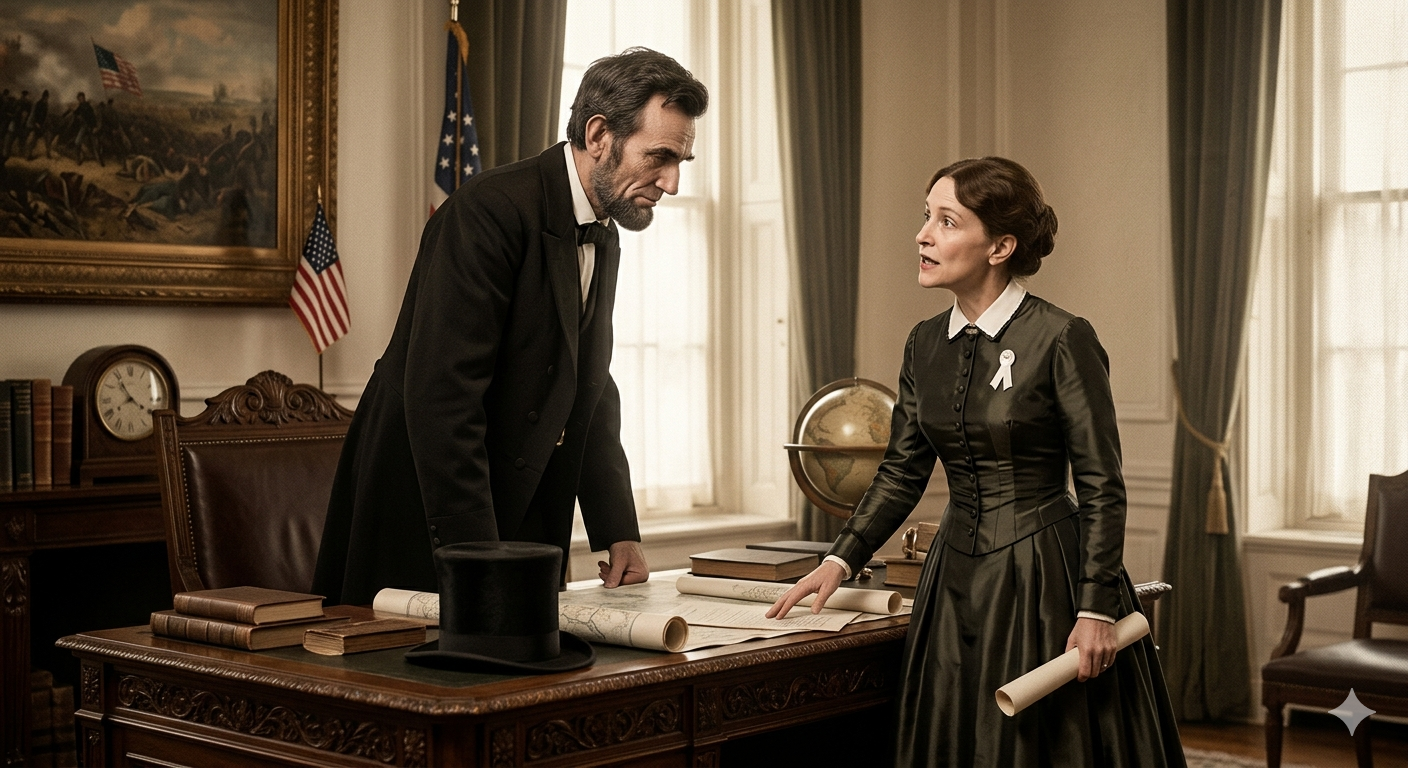
프랜시스 윌라드(Frances Willard) 여사와 에이브러햄 링컨(Abraham Lincoln) 대통령 사이의 관계는 직접적인 교류보다는 정치적 유산의 계승과 도덕적 가치의 공유 측면에서 깊은 연관성을 찾을 수 있습니다.
미국 여성기독교절제회(WCTU)의 전성기를 이끌었던 윌라드 여사가 링컨의 영향을 받았다고 볼 수 있는 주요 근거는 다음과 같습니다.
1. 노예 해방과 절제 운동의 유사성
윌라드는 절제 운동을 **'술로부터의 해방'**으로 정의하며, 이를 링컨의 노예 해방 운동과 동일 선상에 두었습니다.
링컨이 흑인 노예를 신체적 속박에서 구출했다면, 윌라드는 알코올 중독이라는 '도덕적·경제적 노예 상태'에서 미국 가정을 구출하고자 했습니다.
그녀는 링컨을 "위대한 해방자"로 칭송하며, 자신의 운동이 링컨이 시작한 자유의 파도를 이어받은 것이라고 자주 언급했습니다.
2. '링컨의 정당'과 정치적 연결
윌라드 여사는 링컨이 속했던 **공화당(Republican Party)**의 초기 이념에 큰 영향을 받았습니다.
당시 공화당은 노예제 반대뿐만 아니라 청교도적 도덕주의와 사회 개혁을 지지하는 기반이 있었습니다.
윌라드는 링컨이 보여준 '도덕적 결단력'을 정치적 모델로 삼았으며, 이후 그녀가 여성 참정권 운동을 결합할 때도 링컨의 민주주의 원칙을 논리적 근거로 활용했습니다.
3. 상징적 존경과 가문의 배경
윌라드 여사가 성장한 환경 자체가 링컨을 지지하던 북부의 개혁적 분위기 속에 있었습니다.
링컨이 암살된 후, 그는 미국 개혁가들에게 일종의 '세속적 성인' 같은 존재가 되었습니다.
윌라드는 링컨의 검소함, 정직함(Honest Abe), 그리고 평민 출신으로서의 지도력을 자신의 리더십 스타일로 체득하려 노력했습니다.
요약하자면
두 사람은 직접 만난 적은 없으나, 윌라드 여사는 **링컨이 완성하지 못한 '미국의 도덕적 완성'**을 자신이 절제 운동과 여성 운동을 통해 완수하려 한다는 사명감을 가지고 있었습니다. 따라서 윌라드 여사는 링컨을 자신의 정신적 지주이자 사회 개혁의 방법론적 모델로 삼았다고 볼 수 있습니다.
프랜시스 윌라드 여사와 에이브러햄 링컨의 연결고리에 대해 좀 더 살펴보면, 윌라드 여사의 자서전과 당시의 기록을 통해 보면, 그녀에게 링컨은 단순한 정치인이 아니라 **'인생의 이정표'**와 같은 존재였습니다.
1. 윌라드의 자서전에 나타난 링컨에 대한 경외심
윌라드 여사는 자신의 자서전인 **『50년의 회상(Glimpses of Fifty Years)』**에서 링컨에 대한 강한 애정을 직접적으로 드러냈습니다.
21세의 팬심: 1860년 링컨이 처음 대통령으로 당선되었을 때, 윌라드는 일기에 **"내가 아버지와 오빠처럼 그에게 투표할 수 없다는 것이 안타깝다"**고 적었습니다. 당시 여성에게 투표권이 없었음에도 링컨을 향한 확고한 정치적 지지를 보낸 것입니다.
해방 선언의 감격: 1863년 링컨의 '노예 해방 선언'이 발표되자 그녀는 **"400만의 비참한 존재들이 오늘 헌법상 자유인이 되었다... 이 자유라는 선물이 인간의 영혼에 얼마나 큰 것인지 가슴이 벅차오른다"**며 감격했습니다. 이후 그녀는 링컨을 **"우리의 사랑하는 링컨, 해방자(Our beloved Lincoln, the emancipator)"**라고 불렀습니다.
2. '노예제 폐지'를 '술 폐지'로 치환한 논리
윌라드 여사는 링컨의 위대한 업적을 자신의 절제 운동으로 확장하는 영리한 전략을 사용했습니다.
해방의 확장: 링컨이 흑인을 육체적 노예 상태에서 구했다면, 자신은 미국인을 **'술병의 노예(Slavery of the Bottle)'**에서 구하겠다고 선언했습니다. 그녀는 절제 운동을 '제2의 해방 운동'으로 규정함으로써 운동에 도덕적 정당성을 부여했습니다.
링컨의 정당 계승: 그녀는 링컨의 공화당 정신이 단순히 인종 문제에 머물지 않고, 노동자 인권과 여성의 권리, 가정의 보호로 이어져야 한다고 믿었습니다.
3. 리더십 스타일의 유사성: "Do Everything"
윌라드 여사의 유명한 구호인 **"Do Everything(모든 것을 하라)"**은 링컨의 실용주의적 리더십과 닿아 있습니다.
링컨이 연방 유지를 위해 다양한 정치 세력과 타협하면서도 핵심 가치를 지켰듯이, 윌라드 역시 절제 운동을 위해 여성 참정권, 노동법 개정, 아동 보호 등 광범위한 사회 개혁을 하나로 묶는 통합적 리더십을 발휘했습니다.
동시대 평론가들은 수잔 B. 앤서니와 링컨의 리더십이 '영웅적인 삶' 그 자체에서 기인했다면, 윌라드 여사의 리더십은 사람들의 '충성심'과 '도덕적 동의'를 끌어내는 링컨식 지도력과 유사하다고 평가하기도 했습니다.
결론적으로
윌라드 여사에게 링컨은 **'성공한 개혁가의 완벽한 모델'**이었습니다. 링컨이 노예제를 폐지하며 미국 역사의 물줄기를 바꾼 것처럼, 그녀 역시 절제 운동을 통해 미국의 도덕적 수준을 한 단계 높이려 했습니다.
윌라드 여사의 'Do Everything' 정책에 대해 좀더 구체적으로 알아보면, 프랜시스 윌라드 여사의 핵심 철학인 "Do Everything(모든 것을 하라)" 정책은 당시 보수적이었던 여성 운동의 틀을 완전히 깨뜨린 혁신적인 전략이었습니다. 링컨이 연방을 지키기 위해 정치, 군사, 외교 등 모든 수단을 동원했던 것처럼, 윌라드 역시 사회의 모든 문제를 '가정 보호'라는 이름 아래 하나로 묶어냈습니다.
구체적 정책으로는,
1. "Do Everything" 정책의 본질
이 정책의 핵심은 **"모든 사회 문제는 서로 연결되어 있다"**는 믿음이었습니다. 술 문제를 해결하려면 단순히 술을 금지하는 것만으로는 부족하며, 술을 마시게 되는 사회적 배경(빈곤, 교육 부족, 정치적 무권리)을 한꺼번에 고쳐야 한다고 주장했습니다.
2. 구체적인 개혁 사례
여성 참정권 (Home Protection Ballot): 윌라드는 여성에게 투표권이 필요한 이유를 "정치 참여"라는 거창한 구호 대신 **"가정을 술로부터 지키기 위한 방패"**라고 설명했습니다. 덕분에 정치에 거부감을 느끼던 보수적인 기독교 여성들을 대거 참정권 운동으로 끌어들였습니다.
노동 개격 (8시간 노동제): 그녀는 노동자들이 열악한 환경에서 장시간 일하기 때문에 스트레스로 술을 찾게 된다고 분석했습니다. 그래서 '8시간 노동제'와 '아동 노동 금지'를 절제 운동의 공식 의제로 채택하여 노동계층과 연대했습니다.
성교육 및 여성 보호: 당시로서는 파격적으로 여성들에게 자신의 몸에 대해 교육하고, 성폭력으로부터 여성을 보호하기 위한 법적 연령 상향 운동을 벌였습니다.
교도소 및 수용시설 개혁: 수감자들을 무조건 처벌하기보다 교육과 종교를 통해 갱생시켜야 한다고 믿었으며, 여성 수감자를 위한 별도의 수용 시설과 여성 교도관 배치를 주장했습니다.
3. 링컨식 '대통합'의 실천
윌라드 여사의 이 정책이 위대했던 이유는 서로 다른 집단을 하나로 모았기 때문입니다.
남부와 북부의 화해: 남북전쟁 이후 링컨이 그토록 바랐던 '연방의 통합'을 윌라드는 WCTU(여성기독교절제회)를 통해 실천했습니다. 그녀는 남부 여성들을 설득해 북부 여성들과 함께 활동하게 만들었는데, 이는 전쟁 이후 미국에서 가장 성공적인 민간 차원의 남북 통합 사례 중 하나로 꼽힙니다.
글로벌 네트워크: 그녀는 이 운동을 미국에만 국한하지 않고 전 세계로 확장하여 '세계 WCTU'를 창설했습니다.
흥미로운 사실은
윌라드 여사의 이러한 전방위적 활동 덕분에 그녀는 생전에 **"미국에서 가장 영향력 있는 여성"**으로 불렸으며, 워싱턴 D.C. 국회의사당 국립 조각상 홀(National Statuary Hall)에 각 주를 대표하는 인물의 동상이 세워질 때, 일리노이주는 여성 최초로 프랜시스 윌라드의 동상을 링컨의 동상과 함께 나란히 세우기도 했다는 것입니다.
윌라드 여사의 활동 중 특히 그녀가 링컨의 고향인 일리노이주에서 펼쳤던 구체적인 활동을 살펴보면, 프랜시스 윌라드 여사가 링컨의 정치적 고향인 일리노이주에서 펼친 활동은 그녀를 '지방 운동가'에서 '국가적 리더'로 성장시킨 결정적인 발판이었습니다. 특히 그녀가 거점으로 삼았던 **에반스턴(Evanston)**은 오늘날까지도 그녀의 유산이 짙게 남아 있는 곳입니다.
일리노이주에서의 핵심 활동과 링컨의 그림자가 투영된 행보를 정리하자면, 그녀는
1. 노스웨스턴 대학교와 교육 개혁
윌라드는 일리노이주 에반스턴에 위치한 노스웨스턴 대학교(Northwestern University) 내 '에반스턴 여자 대학'의 초대 학장을 지냈습니다.
여성 교육의 개척: 그녀는 여성도 남성과 동등한 지적 능력을 갖추어야 사회를 변화시킬 수 있다고 믿었습니다. 이는 "배움에 굶주렸던" 청년 링컨의 태도와 닮아 있었으며, 여학생들에게 자치권을 부여하는 등 당시로서는 혁명적인 교육 방식을 도입했습니다.
갈등과 결단: 학교 운영 방침을 두고 총장과 갈등을 빚었을 때, 그녀는 학장직을 과감히 내려놓고 '절제 운동'이라는 더 큰 세상으로 뛰어들었습니다. 이 결단력은 링컨이 변호사에서 정치가로 변모하며 시대의 부름에 응답했던 과정과 흡사하다는 평을 받습니다.
2. '에반스턴의 성녀'와 지역 사회 통제
윌라드는 에반스턴을 **"술 없는 도시"**의 모델로 만들고자 했습니다.
철저한 금주 구역: 그녀의 영향력 덕분에 에반스턴은 수십 년 동안 미국에서 가장 엄격한 금주 지역 중 하나가 되었습니다. 그녀는 지역 사회가 도덕적으로 무장될 때 비로소 국가 전체를 바꿀 수 있다고 믿었습니다.
링컨을 기리는 집회: 그녀는 일리노이주 곳곳에서 강연하며 링컨의 일화를 자주 인용했습니다. 특히 링컨이 젊은 시절 술집 점원으로 일하면서도 정작 자신은 술을 멀리했던 일화를 들며, "일리노이의 아들 링컨처럼 우리 아이들을 키우자"고 호소하여 지역 민심을 사로잡았습니다.
3. 국회의사당 조각상 홀의 상징성
앞서 말씀드린 **국립 조각상 홀(National Statuary Hall)**에 그녀의 동상이 세워진 배경은 매우 상징적입니다.
일리노이의 대표: 미국 각 주는 단 두 명의 인물만을 국회의사당에 보낼 수 있습니다. 일리노이주는 수많은 위인 중 에이브러햄 링컨과 함께 프랜시스 윌라드를 선택했습니다.
최초의 여성: 1905년 그녀의 동상이 세워질 때, 이는 국회의사당에 입성한 최초의 여성 동상이었습니다. 링컨이 '연방의 구원자'라면, 윌라드는 '가정의 수호자'로서 일리노이주가 배출한 가장 위대한 인물임을 공식적으로 인정받은 것입니다.
4. 윌라드의 '자전거'와 해방의 철학
일리노이주 에반스턴에서 노년에 자전거를 배우며 쓴 책 **『자전거 타기(A Wheel Within a Wheel)』**는 그녀의 철학을 잘 보여줍니다.
그녀는 자전거를 배우는 과정을 **"자신에 대한 통제권을 얻는 과정"**으로 묘사했습니다.
링컨이 족쇄를 풀어 흑인을 해방했다면, 윌라드는 여성들에게 자전거를 타게 함으로써(당시 자전거는 여성 해방의 상징이었습니다) 신체적 자유와 이동의 자유를 선사하려 했습니다.
윌라드 여사의 집은 현재 에반스턴에서 **'프랜시스 윌라드 하우스 박물관'**으로 보존되어 있습니다. 그곳에 가면 그녀가 링컨의 정신을 어떻게 일상과 운동 속에 녹여냈는지 그 흔적을 직접 확인할 수 있습니다.
윌라드 여사가 링컨의 영향을 받아 쓴 연설문의 내용을 살펴보면, 프랜시스 윌라드 여사가 링컨의 영향을 받아 작성한 연설문의 특징과, 그녀가 링컨의 유산을 통해 강조했던 '기독교적 사회주의' 및 '평화주의' 가치에 대해 알 수 있습니다.
1. 링컨의 어조를 빌린 연설문: "제2의 게티즈버그"
윌라드 여사는 대중 연설에서 링컨의 수사법을 자주 차용했습니다. 특히 링컨이 게티즈버그 연설에서 사용한 **"국민의, 국민에 의한, 국민을 위한"**이라는 문구는 윌라드의 손에서 다음과 같이 재탄생하곤 했습니다.
가정 보호를 위한 변주: "정부는 남성의, 남성에 의한, 남성을 위한 것이 아니라, 가족의, 가족에 의한, 가족을 위한 것이어야 합니다."
도덕적 선언: 윌라드는 링컨이 "집이 스스로 분쟁하면 설 수 없다(A house divided against itself cannot stand)"고 했던 말을 인용하며, "술 권하는 사회와 행복한 가정은 한 지붕 아래 공존할 수 없다"고 역설했습니다.
그녀의 연설은 링컨처럼 성경적 비유가 풍부했고, 짧으면서도 강력한 문장을 사용하여 대중의 감정을 움직이는 힘이 있었습니다.
2. 링컨의 '자유'를 '경제적 정의'로 확대
윌라드 여사는 노년에 이르러 링컨의 평등 사상을 경제적 평등으로까지 확장했습니다.
기독교적 사회주의: 그녀는 링컨이 노예 노동의 부당함을 지적했듯이, 자본주의 체제 하에서의 노동 착취 역시 또 다른 형태의 노예제라고 보았습니다. 윌라드는 "링컨이 흑인의 손에서 쇠사슬을 풀었듯이, 우리는 가난한 자들의 발목을 잡는 빈곤의 사슬을 풀어야 한다"고 주장하며 사회주의적 가치를 수용했습니다.
부의 재분배: 그녀는 링컨의 '자수성가(Self-made man)' 정신을 존중하면서도, 거대 기업의 독점이 개인의 자유를 침해하는 것을 경계했습니다. 이는 훗날 미국의 진보주의 운동에 큰 영향을 끼쳤습니다.
3. 평화와 비폭력: "정치적 원수도 형제로"
링컨이 남북전쟁 종식 직전 "누구에게도 악의를 품지 말고, 모두에게 자애를 베풀며(With malice toward none, with charity for all)"라고 말했던 정신은 윌라드의 활동 전반에 흐르는 기조였습니다.
비폭력 저항: 윌라드는 술집 앞에서 무릎을 꿇고 기도하는 '여성들의 십자군(Women's Crusade)' 운동을 이끌 때, 절대 폭력을 사용하지 않았습니다. 그녀는 상대방을 파괴해야 할 적이 아니라 '계몽해야 할 형제'로 대했는데, 이는 링컨이 남부군을 대했던 태도와 일맥상통합니다.
여성 군대: 그녀는 WCTU를 "하얀 리본 군대(White Ribbon Army)"라고 불렀지만, 그 무기는 총이 아니라 **'순결'과 '설득'**이었습니다.
4. 윌라드가 남긴 링컨적 유산: "기념비의 의미"
일리노이주 에반스턴에는 윌라드를 기리는 기념비와 건물들이 많습니다. 그녀는 살아생전 "링컨 대통령이 보여준 겸손함이야말로 모든 개혁가가 갖춰야 할 최고의 덕목"이라고 입버릇처럼 말했습니다.
윌라드는 자신이 죽은 뒤 거창한 묘비보다는 **"그녀는 할 수 있는 모든 선한 일을 하려 노력했다"**는 링컨식의 소박한 평가를 받길 원했습니다.
실제로 그녀의 장례식에는 수만 명의 인파가 몰려들었는데, 이는 링컨 대통령의 운구 행렬 이후 일리노이주에서 가장 큰 규모의 추모 열기였다고 기록되어 있습니다.
프랜시스 윌라드 여사는 링컨이라는 거인의 어깨 위에 올라타, 그가 정치적으로 다진 자유의 토대 위에 **'가정과 여성의 권리'**라는 아름다운 집을 지은 인물이라고 할 수 있습니다.
The relationship between Frances Willard and President Abraham Lincoln reveals a deep connection in terms of the inheritance of political legacy and the sharing of moral values, rather than in direct interaction.
The main grounds for viewing Willard, who led the heyday of the Women's Christian Temperance Union (WCTU), as having been influenced by Lincoln are as follows:
1. Similarities between the Abolitionist Movement and the Temperance Movement
Willard defined the temperance movement as **'liberation from alcohol'**, placing it on the same level as Lincoln's abolitionist movement.
While Lincoln rescued Black slaves from physical bondage, Willard sought to rescue American families from the 'moral and economic slavery' of alcoholism.
She praised Lincoln as a "great emancipator" and frequently stated that her movement was a continuation of the wave of freedom initiated by Lincoln. 2. Political Connections with 'Lincoln's Party'
Mrs. Willard was greatly influenced by the early ideology of the **Republican Party** to which Lincoln belonged.
At the time, the Republican Party had a foundation supporting not only opposition to slavery but also Puritan moralism and social reform.
Willard adopted Lincoln's demonstrated 'moral resolve' as a political model, and later, when she joined the women's suffrage movement, she utilized Lincoln's democratic principles as a logical basis.
3. Symbolic Respect and Family Background
The environment in which Mrs. Willard grew up was itself situated within the reformist atmosphere of the North, which supported Lincoln.
After Lincoln's assassination, he became a figure akin to a 'secular saint' to American reformers.
Willard strove to embody Lincoln's frugality, honesty (Honest Abe), and leadership as a man of humble origins into her own leadership style. In summary,
Although the two never met in person, Mrs. Willard possessed a sense of mission to complete the "moral perfection of America" that Lincoln had failed to achieve, through the temperance and women's movements. Therefore, it can be seen that Mrs. Willard regarded Lincoln as her spiritual pillar and a methodological model for social reform.
Looking further into the connection between Frances Willard and Abraham Lincoln, her autobiography and contemporary records reveal that, to her, Lincoln was not merely a politician but a figure akin to a "milestone in life."
1. Reverence for Lincoln as Revealed in Willard's Autobiography
In her autobiography, *Glimpses of Fifty Years*, Mrs. Willard directly expressed her strong affection for Lincoln. A 21-Year-Old's Fandom: When Lincoln was first elected president in 1860, Willard wrote in her diary, **"It is a pity that I cannot vote for him like my father and brother."** This demonstrated her unwavering political support for Lincoln, despite the fact that women did not have the right to vote at the time.
The Emancipation of the Proclamation: When Lincoln's 'Emancipation Proclamation' was announced in 1863, she was deeply moved, **"Four million wretched beings have become constitutionally free today... My heart swells with emotion at how great this gift of freedom is to the human soul."** Afterward, she referred to Lincoln as **"Our beloved Lincoln, the emancipator."**
2. The Logic of Substituting 'Abolition of Slavery' with 'Abolition of Alcohol'
Mrs. Willard employed a clever strategy of extending Lincoln's great achievements to her own temperance movement. Expansion of Emancipation: She declared that while Lincoln had saved Black people from physical slavery, she would save Americans from the **'Slavery of the Bottle.' She granted moral legitimacy to the temperance movement by defining it as the 'Second Emancipation Movement.'
Succession to Lincoln's Party: She believed that Lincoln's Republican spirit should not remain merely at the level of racial issues but should extend to workers' rights, women's rights, and the protection of the family.
3. Similarities in Leadership Styles: "Do Everything"
Mrs. Willard's famous slogan, **"Do Everything,"** resonates with Lincoln's pragmatic leadership.
Just as Lincoln upheld core values while compromising with various political forces to maintain the Union, Willard also demonstrated integrative leadership for the temperance movement, unifying broad social reforms such as women's suffrage, labor law reform, and child protection. Contemporary critics have assessed that while the leadership of Susan B. Anthony and Lincoln stemmed from their "heroic lives" themselves, Mrs. Willard’s leadership resembled Lincoln’s style of leadership, which elicited people’s "loyalty" and "moral consent."
In conclusion, for Mrs. Willard, Lincoln was the **"perfect model of a successful reformer."** Just as Lincoln changed the course of American history by abolishing slavery, she too sought to elevate America’s moral standards through the temperance movement.
To examine Mrs. Willard’s "Do Everything" policy in more detail, Frances Willard’s core philosophy—the "Do Everything" policy—was an innovative strategy that completely shattered the framework of the conservative women’s movement of the time. Just as Lincoln mobilized all means, including politics, military, and diplomacy, to protect the Union, Willard unified all of society’s problems under the banner of "home protection." As for specific policies,
1. The Essence of the "Do Everything" Policy
The core of this policy was the belief that **"all social problems are interconnected." It was argued that simply banning alcohol is insufficient to solve the alcohol problem; the social backgrounds that lead to drinking (poverty, lack of education, political inaction) must be addressed all at once.
2. Specific Examples of Reform
Women's Suffrage (Home Protection Ballot): Willard explained the reason women needed the right to vote not with the grandiose slogan of "political participation," but as **"a shield to protect the home from alcohol."** Thanks to this, she drew a large number of conservative Christian women, who had previously felt aversion to politics, into the suffrage movement.
Labor Reform (8-Hour Workday): She analyzed that workers turn to alcohol due to stress caused by working long hours in poor conditions. Therefore, she adopted the '8-hour workday' and 'ban on child labor' as official agendas of the temperance movement to stand in solidarity with the working class. Sex Education and Protection of Women: Radical for the time, she educated women about their bodies and campaigned to raise the legal age to protect them from sexual violence.
Prison and Correctional Facility Reform: Believing that inmates should be rehabilitated through education and religion rather than unconditionally punished, she advocated for separate facilities and the placement of female correctional officers for female prisoners.
3. The Practice of Lincoln-style 'Grand Unity'
The reason Mrs. Willard's policy was great was that it brought different groups together as one.
Reconciliation between the South and the North: After the Civil War, Willard put into practice the 'unity of the Union' that Lincoln so ardently desired through the WCTU (Women's Christian Temperance Union). She persuaded Southern women to work alongside Northern women, which is considered one of the most successful examples of civilian-level North-South integration in the United States after the war.
Global Network: She did not limit this movement to the United States but expanded it globally, establishing the 'World WCTU'. An interesting fact is that, thanks to these all-encompassing activities, Mrs. Willard was called the "most influential woman in America" during her lifetime, and when statues representing each state were erected at the National Statuary Hall in the Capitol Building in Washington, D.C., Illinois became the first state to erect a statue of Frances Willard alongside that of Lincoln.
Looking at the specific activities she carried out, particularly in Lincoln's home state of Illinois, it becomes clear that her work in Lincoln's political home served as a decisive stepping stone that transformed her from a "local activist" into a "national leader." In particular, Evanston, the base she established, remains a place where her legacy is deeply ingrained to this day. To summarize her key activities in Illinois and her actions that reflected Lincoln's shadow, she:
1. Northwestern University and Educational Reform
Willard served as the first president of Evanston College, located within Northwestern University in Evanston, Illinois.
Pioneering Women's Education: She believed that women needed to possess intellectual capabilities equal to those of men to bring about social change. This resembled the attitude of the young Lincoln, who was "starved for learning," and she introduced educational methods that were revolutionary for the time, such as granting autonomy to female students.
Conflict and Determination: When she clashed with the president over school administration policies, she boldly stepped down from her position as president and plunged into the larger world of the "temperance movement." This decisiveness is considered to be similar to the process by which Lincoln responded to the call of the times as he transformed from a lawyer into a politician.
2. The "Saint of Evanston" and Community Control
Willard sought to make Evanston a model of a **"alcohol-free city"**. Strict Prohibition Zone: Thanks to her influence, Evanston became one of the strictest prohibition zones in the United States for decades. She believed that only when a community was morally armed could it change the entire nation.
Rallies Honoring Lincoln: She gave lectures throughout Illinois, frequently citing anecdotes about Lincoln. In particular, she captivated local sentiment by citing the story of Lincoln working as a barmaid in his youth while abstaining from alcohol himself, appealing to the audience to "raise our children like Lincoln, the son of Illinois."
3. The Symbolism of the National Statuary Hall
The background behind the erection of her statue in the aforementioned **National Statuary Hall** is highly symbolic.
Representative of Illinois: Each U.S. state is allowed to send only two figures to the Capitol. Among numerous great figures, Illinois selected Frances Willard alongside Abraham Lincoln.
The First Woman: When her statue was erected in 1905, it was the first female statue to enter the Capitol. If Lincoln is the "Savior of the Union," Willard was officially recognized as the "Guardian of the Home," the greatest figure Illinois has ever produced.
4. Willard's "Bicycle" and the Philosophy of Liberation
The book ***A Wheel Within a Wheel***, which she wrote while learning to ride a bicycle in her later years in Evanston, Illinois, clearly illustrates her philosophy.
She described the process of learning to ride a bicycle as **"the process of gaining control over oneself."**
If Lincoln liberated Black people by breaking their shackles, Willard sought to grant physical freedom and freedom of movement to women by having them ride bicycles (at the time, the bicycle was a symbol of women's liberation).
Mrs. Willard's home is currently preserved in Evanston as the **Frances Willard House Museum**. Visiting there allows you to see firsthand the traces of how she incorporated Lincoln's spirit into her daily life and exercise. Examining the content of the speeches written by Mrs. Willard under the influence of Lincoln reveals the characteristics of speeches written under Lincoln's influence, as well as the values of 'Christian Socialism' and 'Pacifism' that she emphasized through Lincoln's legacy.
1. Speeches Borrowing Lincoln's Tone: "The Second Gettysburg"
Mrs. Willard frequently borrowed Lincoln's rhetoric in her public speeches. In particular, the phrase **"of the people, by the people, for the people"** used by Lincoln in the Gettysburg Address was often reborn in Willard's hands as follows:
A Variation for the Protection of the Family: "Government must not be of men, by men, for men, but of the family, by the family, for the family."
A Moral Declaration: Citing Lincoln's remark that "A house divided against itself cannot stand," Willard emphasized that "a society that encourages drinking and a happy family cannot coexist under one roof." Like Lincoln, her speeches were rich in biblical metaphors and possessed the power to move the emotions of the public by using short yet powerful sentences.
2. Expanding Lincoln's 'Freedom' to 'Economic Justice'
In her later years, Mrs. Willard extended Lincoln's concept of equality to include economic equality.
Christian Socialism: Just as Lincoln pointed out the injustice of slave labor, she viewed labor exploitation under the capitalist system as another form of slavery. Willard embraced socialist values, arguing, "Just as Lincoln broke the chains from the hands of the Black man, we must break the chains of poverty that hold the poor back."
Redistribution of Wealth: While respecting Lincoln's spirit of the 'self-made man,' she was wary of the monopolies of large corporations infringing upon individual freedom. This later had a significant influence on the American Progressive movement. 3. Peace and Nonviolence: "Treating Political Enemies as Brothers"
The spirit of Lincoln, who said just before the end of the Civil War, "With malice toward none, with charity for all," was the underlying principle running throughout Willard's activities.
3. Nonviolent Resistance: When Willard led the "Women's Crusade" movement, in which women knelt and prayed in front of taverns, she never used violence. She treated her opponents not as enemies to be destroyed, but as "brothers to be enlightened," a stance consistent with Lincoln's attitude toward the Confederate Army.
Women's Army: Although she called the WCTU the "White Ribbon Army," its weapons were not guns, but **'chastity' and 'persuasion'**.
4. Willard's Lincolnian Legacy: "The Meaning of Monuments"
There are many monuments and buildings in Evanston, Illinois, that honor Willard. During her lifetime, she habitually said, "The humility shown by President Lincoln is the greatest virtue every reformer should possess."
Willard wanted to receive a modest, Lincoln-style evaluation after her death—that she "tried to do every good thing she could"—rather than a grandiose tombstone.
In fact, tens of thousands of people flocked to her funeral, which is recorded as the largest outpouring of mourning in Illinois since President Lincoln's funeral procession.
Frances Willard can be described as a figure who stood on the shoulders of the giant Lincoln and built the beautiful house of "family and women's rights" upon the foundation of freedom he politically established.
'리더십이야기' 카테고리의 다른 글
| [하우스리더십학교] 제26-19강 혼돈의 시대 리더의 탄생-36(프랭클린루스벨트_오피니언리더십) (1) | 2026.05.10 |
|---|---|
| [하우스리더십학교] 제26-18강 혼돈의 시대 리더의 탄생-35(프랭클린 루스벨트_실용주의적 리더십) (0) | 2026.05.03 |
| [하우스리더십학교] 제26-17강 혼돈의 시대 리더의 탄생-34(미탄광파업의 해결) (0) | 2026.04.26 |
| [하우스리더십학교] 제26-16강 혼돈의 시대 리더의 탄생-33(시어도어 루스벨트_문제해결의 리더십) (0) | 2026.04.19 |
| [하우스리더십학교] 제26-15강 혼돈의 시대 리더의 탄생-32(시어도어 루스벨트_미탄광파업 중 리더십) (1) | 2026.04.12 |